"The building reflects the history of the village which, until recently, has always been small, and never wealthy."The dedication to St Nicholas, patron saint of children, was borne out by the presence of a church banner, and by fragments of a 14C wall painting of the saint on the North wall.
Monday, August 31, 2009
Some Bucks churches
Sunday, August 30, 2009
Hunting the Green Man - NE Herts
SR WALTER AT LEA, AL'S SIR WALTER AT CLAY 1350 TO CIRCA 1395
Sunday, August 23, 2009
Hunting the Green Man - West Hertfordshire and Beds
Just as an aside, I've been trying to use the OnTheRoad service on the web to help plan my trips. I can add a trip description, select places on the map as 'stops' and add notes for these stops. The idea being that whilst out on the trip, I can then upload stories and geotagged photos for each place from my phone (Android and iPhone are currently supported). Unfortunately, having added the stops I wanted, and made notes on each of them (postcode for the GPS, points to look out for etc.) I could find no way to retrieve this information from the system again apart from re-editing each item individually on the PC. I couldn't see the information at all on the phone. It would be useful if I could have printed out a trip plan with all the stops and notes on it. Ah well, another request for the developers...
But this weekend, I've at last got something to report. Out of a total of seven churches visited today, two had evidence of the Green Man in different guises. And more importantly, I may have tentatively identified a Sheela figure which I've not seen listed previously elsewhere!
Aldbury St John the Baptist
The church in this picturesque village is just to the west of the village pond, which also features stocks and a whipping post.
The main attraction in the church is the spectacular Pendley Chapel in the south aisle screened from the rest of the church by a stonework screen. A wildman, or wild wose, clutching his club is reclined at the foot of Sir Robert Whittingham, builder of the nearby Pendley Manor. His wife lies alongside him, with a (battered) hind at her feet. The stonework apparently dates from the 1500's, and is particularly fine. The wildwose is of course a relative of the Green Man.
I have visited this church previously, but have yet to get a satisfactory picture of the wildwose, due to the lighting conditions and crampedness in the chapel.
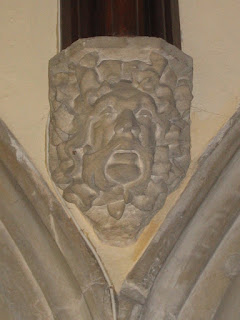
There is also, on the north wall an old stone head corbel which provoked my interest. The head is quite damaged on one side, but the side remaining shows an arm looped under a leg. If this pattern were symmetrical on the other (damaged) side, then there's a possibility that this could be the remains of a sheela-na-gig type figure. The problem is that the figure would then be wider than the apparent width of the corbel itself. There is only brief mention of the corbel in the church guide, which suggests a 13th century date for the carving, but gives no other information.
So a mystery remains.
Little Gaddesdon, SS Peter and PaulThis pretty little church lies half a mile from its village, and contains several memorials to the Egerton family, who occupied the nearby Ashridge Estate in the 1700s. I'd arrived shortly after a service had concluded, and a couple of gentlemen were just locking up the vestry, but were happy for me to have a look around. When I mentioned my Green Man interest, they had little idea, and one of them stated as he was leaving that he knew of no such symbology in the church.
I was therefore pleased and surprised to find not one, but three foliated head images on a late stained glass window on the south wall, each similar but differing in very small ways from the others.
Sadly, the rest of the trip held no such finds, but I'll document the negative hits here anyway for completeness.
Nettleden St Lawrence
This church was locked when I arrived, though it has a magnificant avenue of 12 yew trees leading to from the road to the porch. The outside is rather plainly decorated, I've no idea if the inside will hold any treasures.
Great Gaddesdon St John the Baptist
A service was in progress when I arrived, but the church door was open, and I could see decorated capitals on the columns, so there may be some hope if I pass this way again in future. Externally the main points of interest here are the Norman gargoyles on the tower, and the proliferation of puddingstone, often used in prehistoric times to waymark paths and river crossings - the Gade flows nearby. There is a large lump of this stone in the churchyard to the south of the porch, and another on the north side. In addition, puddingstone has been used as a base for several of the buttress points on the north side. A similar practice of using such large stones has been interpreted in other areas as a 'stamping down' on previous pagan practices - see Pewsey church in Wiltshire as an example of this.
At this point, we crossed the border into Bedfordshire to check out the final three churches for the day:
Studham, St Mary
Preparations were underway for a service, and the place was full of some of the most fragrant flowers after a wedding the previous day. Sadly though, the stonework in the chancel is in dire need of repair work, which it is thought could take a few years to complete. After that, the tower will be in need of attention too.
The only item of any interest here, and the oldest item in the building, was the font. This contains a carving of some mythical beasts, a couple of which had florate tongues. Not quite a Green Man motif, but as close as I was able to get in this small church at the end of a countryside cul-de sac.
Whipsnade St Mary Magdelene
Quite simply, one of the plainest churches I've seen for quite some time. No south door, no porch, no stained glass. A service had just finished, so I poked my head in the door, having already looked through the plain windows. No decoration of any type. The church was built in the 1500s and updated by Hawksmoor in 1719. It could have been built by an anonymous 1960s council planner for all that I could see. Time to move on.
Kensworth St Mary
I didn't realise it at the time, but I was racing the vicar here from Whipsnade! Parishioners were arriving for the service as I got here. In my trip preparation, I'd noted that the main door has some interesting Norman carving, so I was hopeful. I tentatively entered the porch and took a couple of photos, but was spotted. A friendly gentleman invited me inside to take a look around before the service started. On mentioning my search, his response was 'Oh, that's a pub, isn't it?'
I explained briefly about the Green Man and he said he could show me a couple of heads which may be of interest in the tower, above what used to be the main west door. However, these were part of the original Norman stonework and not related to my search, sadly. He was quite friendly and interested though, even pointing out to me the scratch sundial inside the porch, a remnant from before the porch was built. He missed the more interesting fantasy beast carvings on the capital of the south door columns though...
The church also contained some decent memorial glasswork in the windows, and I took my leave just as the vicar was arriving. No point in becoming a captive audience, is there?
So a productive day's trip. A couple of decent hits and enough to keep my enthusiasm for the search up.
This post has definitely got me interested in writing these again, so look out for some 'catch-up' articles over the next couple of weeks, outlining the negative hits over the summer so far.
Sunday, May 24, 2009
Hunting the Green Man, Essex part 3
So which was the lucky winner? Let's get that out of the way first.
Thaxted, St John the Baptist
This church is quite spectacular externally, and is known as the 'Cathedral of Essex'. Every nook and cranny is seemingly filled with carvings of heads, faces, animals and various mythical beasts. There were far too many to count, each pinnacle having at least four faces.
Our man was on the west side of the South Porch and was of what I consider to be the 'classical' style, whilst on the north side I spotted at least two club-wielding Wild Woses, one taking pride of place on a pinnacle the North Transept.
This is a church I shall definitely have to return to in future. Who knows what delights await us inside? Entry to the church is unusually via the North porch, using a 'door within a door'.
Whilst in Thaxted, it would be boorish not to mention some of the other historical delights of the place, which include a Guildhall dating from 1390 (earlier than the church itself), and next to it a cottage where Dick Turpin was reputed to have lived.
Thaxted was also home to Gustav Holst, composer of the Planets Suite, and hosts a working windmill. the Thaxted Morrismen are supposedly one of the oldest sides in the country, and feature on the town signs at the North and South approaches to the town. The side were not in evidence during our visit, though there is a Fayre tomorrow (Bank Holiday Monday) where they will be dancing out.
Ok, so Thaxted was an interesting stop and worth a visit all by itself, but where else did we go today? A brief list should suffice for our purposes as none of the other churches visited showed any external evidence of the Green Man, which is our main focus here.
Little Chesterford, St Mary the Virgin - there was a sign in the porch listing keyholders, but it was quite an early start for us, far too early to wake a keyholder!
Littlebury, Holy Trinity - this church had some ornate corbel heads on the East end of the church, but they almost looked too unworn to be of any age. The church was locked.
Radwinter, St Mary - the Service was just about to commence - bells were calling the parishioners in as I arrived, though I suspect many of them were attending the Boot Fair in nearby fields across the road. The church has an interesting 2 storey South porch, so may be worth a revisit if in the area.
Great Sampford, St Michael - a notice stated that the church is 'normally open. Summer 10-4, Winter 10-3'. It was 8:30 in the morning when we got here...
Little Bardfield, St Katharine - a delightful little church, set back from the road, and which was open. No evidence of the Green Man, internally or externally. There was a guide book for sale at £6.50, but a scan through the demo copy suggested this was more about the history of the parish and its people rather than the structure of the church.
Great Bardfield, St Mary the Virgin - locked tight, but the presence of Clerestory windows suggests that any possible Green Man roof bosses inside would be impossibly high and difficult to see.
Finchingfield, St John the Baptist - A Christening appeared to be in progress so I could not gain entry to the church itself. Several heads on the window stops appeared to be modern, one sporting what appeared to be aviator goggles! There was an older mouth-puller figure on the northwest side of the tower though (difficult to photograph against the sun).
The village itself is beautiful, but was busy with the hum of motorbike engines around the village pond. It seems to be one of those places they all converge on when the weather is as pleasant as it was today.
Looking at the map after the journey, it never fails to amaze me just how many churches there are still left to visit in this area.
See this trip on TravelSkoot.
Sunday, May 03, 2009
Hunting the Green Man - West Penwith pt 1
This week, we're in Cornwall on holiday. Each time we come down here, I set a target of things to see - we've seen many of the ancient prehistoric monuments, and a large percentage of the old Cornish crosses and Holy Wells that cover the county from Launceston to Land's End. In the pursuit of these last targets, I've visited many of the small parish churches, but never before have I taken particular notice of any carvings in the churches.
And so, on the first day of our holiday, I started to revisit some of the churches that I know, this time in a slightly more organised manner. Most of the Cornish churches are built of granite, which does not carve that easily. Luckily, I uncovered several wooden Green Man figures, mainly as roof bosses. This first batch of visit reports (and a negative report is as useful as a positive one for those who may wish to follow my steps) concerns churches on the West Penwith peninsular. Warning - this could end up being a long post!
Gulval, St Gluvias
On all previous attempts, I have been unable to gain access here, as it is usually locked apart from a brief opening on Saturday mornings, and the usual Sunday Services. As we'd been early leaving London, I'd made a special effort to get here for the Saturday opening, and was well rewarded. The vicar was in residence and I explained my self-imposed task. Although he couldn't help me directly, he wished me well and left me to look around. I checked the roof bosses and spotted a gilded face, with what looked like a moustache of leaves. I'm not fully convinced as yet, but will count this as my first hit of the week.
On perambulating the church, I spotted an unusual chair in the north aisle. I asked the vicar, who knew nothing about it, and also checked the church guidebook, which did not mention it at all. The chair was crudely carved, the back included a standing figure wearing what looked like fur shorts, and carrying a club. Could this be a faun? There was another figure cowering under a tree. The top of the chair back showed a possible green man on one side, and a copy of the figure on the seat - what looked like a bearded 'merman', but with a foliate tail. What is the story behind this strange chair?
Ludgvan, St Ludgvan & St Paul
I was surprised to find this church open, as it has been locked on previous visits unless someone was in attendance, cleaning or suchlike. This time I had the place to myself. I quickly identified two roof bosses, one a classic Green Man, the other a face (female?) within a foliate frame. There are also corbelled heads on the tower, but these are too worn to make out any distinct details.
Madron, St Maddern
On arrival here on Sunday morning, the vicar (the same one at Gulval previously) was just locking up as he had another service to attend elsewhere. He suggested I return later in the day after the later service, and I'm glad I made the effort to get back here.
Madron church contains over 200 roof bosses, and a great many of them appear to be copies of, or similar to the foliate framed head that I saw in Ludgvan.
However, the main prize was to found in the choir, where two fine poppy head bench ends were found, one male and one female, both of the Green Man type.
Morvah, St Brigit of Sweden
This church is apparently the only one in Britain dedicated to Brigit of Sweden. A service was being prepared, but I could easily see that there was very little decoration in the church, and no chance at all of finding my target here.
Pendeen, St John
This church was locked during my visit, though I have gained access on previous visits.
St Just, St Just
This church has always been open whenever I've visited, but has no Green man symbology that I can find.
Sancreed, St Credus
This church was locked during my visit, and has always been locked on previous visits. I suspect the church is only opened for the early morning Sunday service.
I hope to get around the majority of the Penwith churches later in the week.
Saturday, April 25, 2009
Hunting the Green Man - Essex part 2
Today we made an early start, armed with another list of six Essex churches to visit in our quest for the Green Man, with information taken from the CotGM web site gazetteer.
Matching St Mary: 'South wall corbel end'
The head is inside, on the east side of the South door. It's partner on the other side of the door is a double 'face-puller', another favourite motif of mine. I wouldn't say this Green Man is a classic, again only 2 oak leaves coming from the mouth, no other foliage in evidence. Also, the inside of the church has been heavily whitewashed, obscuring any possible finer details. The figure is mentioned in passing in the church guide, but no mention of its 'green' credentials at all.
White Roding St Martin: 'Horned god corbel, end of chancel on Southside'
Sadly, the church was locked, no access, so nothing to report. I was looking forward to meeting a 'horned god' in church too!
High Easter St Mary: 'Above door'
I could see nothing that looked remotely like a green man, either externally or internally above any of the doors. The roof supports are finely carved, but it was very dark that high up, and no details could be seen. There were some faces, but these could have been cherubim or angels - certainly no foliage was in evidence. Externally there were some heads on the high windows of the tower which looked suspicious, but use of a zoom lens showed these to be leonine beasts rather than the Green Man.
The West door of the tower is a possible candidate for the location as the church guide states: "..a fine doorway with a pointed arch beneath a rectangular frame, the spandrels being carved with two men (?) (sic) on the north and a winged animal on the south; a much eroded bust of an angel holding a shield is at the apex. the hood-mould and string course over are carved with animal heads, Fleur de Lys and other motifs."
It's always possible that one or more of the 'animal heads' has been misinterpreted as a Green Man, as they are very eroded.
Great Canfield St Mary: 'South Porch'
The church itself was locked, but there was access to the porch. The South door of the church has some fine Norman carving. On the left is a bearded figure with two birds, on the right is another face, with a serpentine beard, definitely neither are a Green Man. I saw no other external carvings but could not gain access to inside the church.
Behind the church is some 'waste land' - a break in the church boundary shows a used path leading down into a dip. On closer inspection, the dip is a moat for an old Motte and Bailey Norman stronghold - the outline can be clearly seen on Google Earth satellite imagery.
Update: the heads pictured above apparently depict Norse mythology, as described here.
Little Dunmow St Mary: 'Interior (unconfirmed)'
The church was locked, but keyholders were listed and I gained entry. An interesting church, originally the Lady Chapel of a much larger abbey on the site of which little/no trace remains. There is a tomb to Matilda Fitzwater, who may or may not have been the Maid Marian of Robin Hood fame, Robin Hood himself having Green Man connections of course :-) There are some carved heads on the South windows, but as always on a sunny day, it's difficult to take meaningful pictures of these when facing into the sun. I noted one bestial head, and a bearded figure with long hair, but no foliage at all. Below the South windows are some stone panels with fine carvings of beasts and suchlike. Again, these were examined, but no trace of a GM anywhere that I could see.
Could either of the central figures above bee considered as Green Men? I don't think so.
Great Dunmow St Mary: 'North Wall'
Another locked church but keyholders were listed and I gained entry. The exterior of this church is emblazoned with small portrait heads on all windows except a couple on the North side, and all external drainpipes (dated 1907) have large gargoyle heads. All that is, apart from one on the north wall of the tower, which is a classic Green Man.
The CotGM gazetteer states this is C14, but I don't see how it would have survived on an external wall for all that time in such fine condition. The design is almost identical to some 'modern' GM plaques I've seen available in garden centres and the like. I spoke to the keyholder, but he was unaware of the Green Man at all, let alone the fact that such a fine example was on the wall less than 50 yards from his house! With such a fine collection of heads on the outside, I was disappointed by the interior. Any possible heads seem to have been eroded or removed from the columns. I saw two locations that seemed to have a foliate border to them in 'classic' style matching the head outside, but there was no evidence that these had ever had faces on their fronts. The thick, ever present whitewash made making out any details at all extremely difficult.
So that's it, only 2 new photos for the collection, out of 6 churches visited. Not a good return for the trip, but hopefully the information given will help flesh out the gazetteer some more.
Next week we're off to Cornwall for a break. Doubtless I'll be hunting unlisted Green Men whilst down there, and I'll report any finds both here and to the CotGM web site for addition to the gazetteer.
See this trip on TravelSkoot.
Saturday, April 18, 2009
Hunting the Green Man - Essex part 1
This week it's the turn of Essex, and another 6 churches have been lined up for examination. At the moment, I'm only interested in the churches that are on the current CotGM gazetteer. No doubt I'll check out churches not on the list at some future point. The current goal is confirmation of what's listed.
Shenfield St Mary's: 'Font'
The church was open when I arrived, and there is certainly a 'face' on the Font. Not what I would call a true GM, though the hair is certainly foliate. The font is made of Normandy stone and installed in 1390. In 1862 the font was removed to the churchyard. It was replaced by an Italian marble font in 1878. In 1895 the original font was purchased for use in Marsworth church in Bucks. In 1949 after much petitioning it was returned to Shenfield (Information taken from the church guide).
Doddinghurst All Saints: 'Font'
The church was locked, no access, so nothing to report. I've been here before, and it was locked then too, I may have to time a visit for the end of one of their services in future.
Mountnessing St Giles: 'Nave central pillar'
The church was locked, no access, so nothing to report. I've been here before, and it was locked then too. There is a phone number for a keyholder, but I got no reply when I called it. Again, a return visit after a service may be called for.
Margaretting St Margaret: 'Font, corbel ends nearest tower'
An interesting church, I had to collect and sign for a key the size of my hand, then cross a railway line to get access to the church! Two oak leaves coming from the mouth just about class these as Green Man corbels. I wouldn't class the font figure as a Green Man though as this was a classic 'tongue-poker' face.
Stock Harvard All Saints 'Tower bosses, and above Priest's door'
I couldn't get access inside the church as a service was in session (only 1 or 2 parishioners - literally! - Hardly seems worth the effort, but the priest was giving it some in all his finery :-)) The Green Man on the Priest's Door on the south side is a jolly little chap though! There is also an odd stone head (not a Green man) on the wall behind the tower. I'll return another day to check out the interior.
West Hanningfield St Mary & St Edward - was locked, no access, so nothing to report.
So 3 out of 3 wasn't bad. If nothing else, I've confirmed the details for those three. More to come in Essex...
See this trip on Travelskoot.